

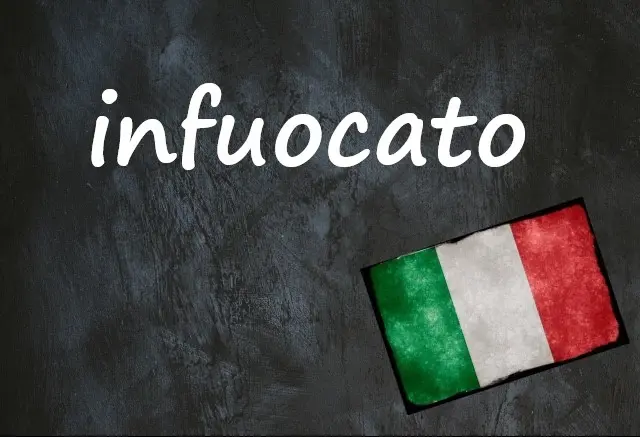
Italy’s biggest holiday week in mid-August is known for almost always being one of, if not the hottest of the summer.
And this year will be no exception, as extreme heat warnings have been issued for almost every part of the country.
No wonder, then, that we’re seeing so many mentions of today’s word in the Italian media at the moment.
Infuocato is an interesting adjective that doesn’t translate literally into English - and yet, Italian learners can probably grasp its meaning without needing much of an explanation.
It’s derived from the word fuoco, meaning fire, and could be translated into English as ‘fiery’, ‘scorching’, or even ‘inflamed’. Literally though, it means ‘placed in the fire’.
The same construction can be seen, for example, in the similar adjective infornato - ‘placed in the oven’. Infornare is used quite simply to mean just that: to put/place/bake something in the oven (forno). You might spot it in Italian recipe books.
Infuocato though is unlikely to be used as literally. It’s instead used most commonly to talk about scorching weather:
Ieri era una giornata di estate infuocata
Yesterday was a blistering hot summer’s day
Unsurprisingly, this dramatic-sounding word is a favourite in Italian media headlines:
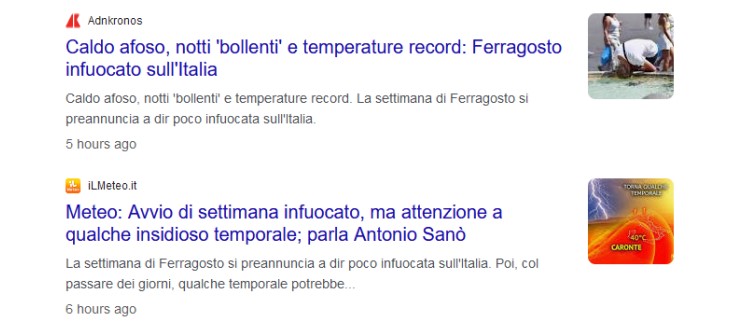
"Caldo afoso, notti 'bollenti' e temperature record: Ferragosto infuocato sull'Italia"
'Humid heat, boiling nights and record temperatures: fiery Ferragosto in Italy' - a headline from news agency Adnkronos on August 12th, 2024.
"Meteo: Avvio di settimana infuocato, ma attenzione a qualche insidioso temporale; parla Antonio Sanò"
'Weather: Scorching start to the week, but watch out for some treacherous thunderstorms, says [weather forecaster] Antonio Sanò' - a headline from weather website IlMeteo.it on August 12th, 2024.
And an alternative (but just as perfectly Italian) meaning for infuocato is “in the grip of strong passion, whether of love or anger”, according to the dictionary. In this emotional sense, it could be translated as ‘ardent’, 'fervent', or 'burning'.
In any case, it's a word you're more likely to read than to hear or use in everyday conversation, but if you do attempt it, here's how it should be pronounced.
The Italian language, fittingly enough, has no shortage of adjectives used to talk about very hot weather: a couple of synonyms given by dictionaries for infuocato are cocente, torrido, and rovente.
See how many of those colourful words you can drop into the conversation during your Ferragosto lunch: or if it's too hot for that, you can always stick to a trusty fa caldo.
Do you have a favourite Italian word you’d like us to feature? If so, please email us with your suggestion.
Make sure you don't miss any of our Italian words and expressions of the day: download our app (available on Apple and Android) and then select the Italian Word of the Day in your Notification options via the User button.
Comments