
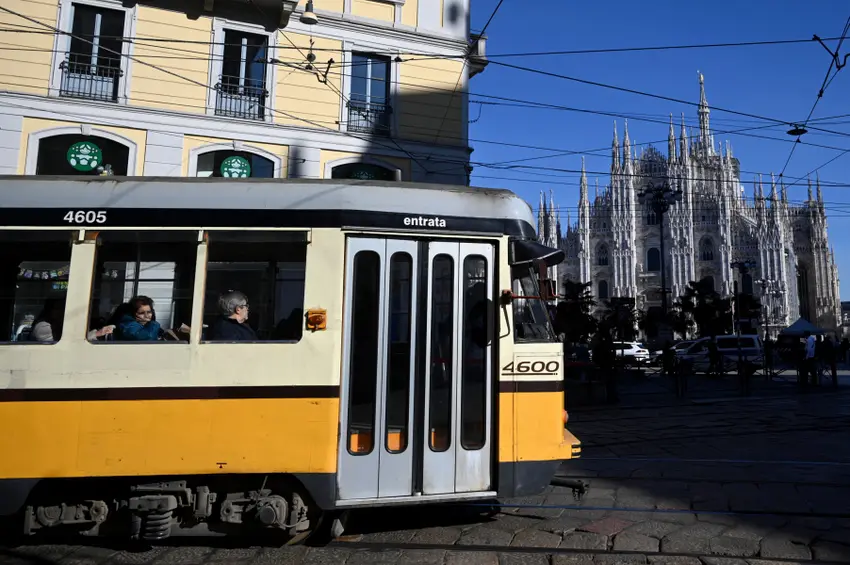
Public transport passengers face disruption amid 24-hour national strike
Passengers in cities around Italy, including Milan, Turin and Catania, were expected to face delays and cancellations on Friday as staff at local public transport operators took part in a 24-hour strike.
The walkout was set to affect all types of local public transport, from surface services (buses, trams, commuter trains and ferries) to underground metro lines, but wasn’t expected to impact long-distance rail services and taxis.
READ ALSO: How will Italy's nationwide public transport strike affect travel on Friday?
According to Italian media reports, commuters in most major cities were expected to experience at least some level of disruption on Friday, though the strike could also have an impact on transport services in smaller cities and towns.
The protest was called in mid-September by unions AL-COBAS and SI-COBAS to protest against “the privatisation of local public transport services” and demand “a minimum wage of 1600 euros net per month [...] and a reduction in working hours”.
Grave of lost World War Two British soldier identified in Italy
The grave of a British soldier who died in Italy during World War Two was identified 81 years after his death, UK authorities said on Thursday.
Trooper Frederick Stobart, from Sunderland, served in the Royal Tank Regiment and was killed by German soldiers in 1943 after becoming a prisoner of war.
He was buried as an unknown casualty at the Commonwealth War Cemetery in Bolsena, Lazio, but was recently identified thanks to excerpts from a Red Cross interview with Stobart’s fellow prisoner of war, Private Quinn.
Stobart was commemorated at a rededication service at the Bolsena War Cemetery in Italy on Wednesday.
Geert Bekaert, the cemetery’s director for central and southern Europe, said it was “a privilege to care for his grave and all those that lie here at Bolsena War Cemetery, in perpetuity".
2.2 million households in Italy live in ‘absolute poverty’: national statistics office
Just over 2.2 million households in Italy – 8.4 percent of the total – lived in conditions of absolute poverty in 2023, meaning they were unable to purchase essential goods and services, national statistics institute Istat said in a report on Thursday.
The report said that some 30.4 percent of households with at least one foreign national lived in absolute poverty compared to 6.3 percent of all-Italian households.
Around 998,000 households (45 percent) experiencing absolute poverty lived in the north of the country, while 859,000 (41,4 percent) lived in the south, with the remaining 16.2 percent located in central regions.
Some 1.29 million minors – 13.8 percent of the total – lived in absolute poverty in 2023. This marked the highest figure recorded since 2014.
PM Meloni presents Italy-Albania migrant deal at Brussels meeting
Italian PM Giorgia Meloni on Thursday presented Italy’s contested migrant deal with Albania during an informal meeting with ten member states ahead of an official EU summit in Brussels, Ansa reported.
The meeting came a day after the first group of migrants arrived in Italian-run reception centres in northern Albania.
Besides the leaders of ten member states, including Denmark, the Netherlands and Austria, the meeting was attended by EU chief Ursola Von der Leyen.
Earlier this week, Von der Leyen called on EU nations to explore “return hubs” outside the bloc as a possible way to reduce irregular arrivals, citing the Italy-Albania deal as a model.
READ ALSO: First migrants arrive in Albania under contested Italy deal
But as EU leaders prepared to meet in Brussels, divisions over the idea of creating migrant "hubs" persisted.
German Chancellor Olaf Scholz dismissed the concept as being able to absorb only "very few small drops", saying it wasn’t a “solution for a country as large as Germany".
With reporting from Alexa Ahern.
Comments