
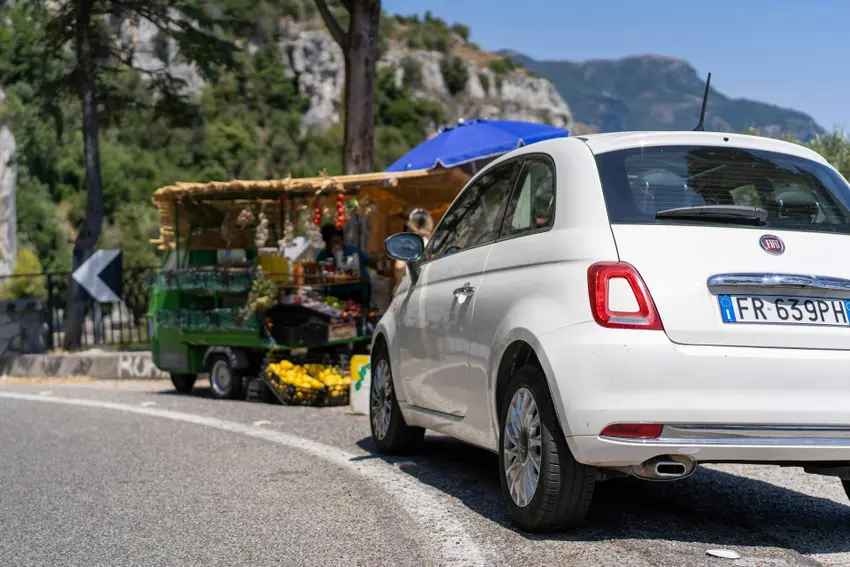
Consider if you really need a rental car
Some places in Italy are best experienced by car.
You may value the freedom of a vehicle when climbing mountain passes in the Dolomites or touring through the national parks of Abruzzo – and some regions, like Puglia, Sicily or Calabria, offer limited public transit options.
But many of Italy’s biggest and best-known locales are well connected by other forms of transit.
These trips can be a lot more relaxing than finding parking in a busy city.
Before you rent a car (noleggiare un auto) to drive around Rome, Naples, the Amalfi Coast or any other high-traffic destination, make sure to take a look at your options without a personal vehicle.
Driving in some of Italy’s bigger cities can also be very daunting for inexperienced drivers – so make sure you feel confident on the road before you decide to travel by car.
Shop around
You may have a favourite website when it comes to renting a car, but in Italy it can really pay to search widely through a number of online brokers.
Prices between sites like Expedia, Rentalcars.com, Auto Europe and VIP Cars can vary by as much as 50 percent or more.
Always be sure to confirm where your rental is actually located. Often, searches in Italy will give you rental cars at the nearest airport when there may be rental agencies much closer.
At times, a search will recommend a rental location in an industrial estate that costs dozens of euros to reach by cab.
If you’re renting over a weekend, it can be worth checking if it actually saves you money to add a day and return the car on a Monday.
Some rental agencies, particularly in city centres, will close on Sunday, which may limit your available options.
Lastly, make sure to check the reviews of your rental agency.
Italy has a number of companies that have poor reputations with their customers. Checking the ratings on Google Maps will quickly turn up stories from those who've been taken advantage of.
Check for hidden fees
Italian rental agencies love hidden fees, so it pays to read the fine print.
Certain low-cost rental agencies are known for adding interior cleaning fees, refuelling fees, additional driver fees and insurance fees that bump up their impossibly low base price.
If you don’t recognise the rental agency or haven’t used them before, it’s worth reading their policies in full on their website to make sure you aren’t surprised by an unexpected expense.
Often, the cheapest option isn’t the best.
If a rental company is beating out their competitors by a lot on price, you can bet that you will end up paying the difference in some other way.
Get insurance
The most common rental car scam in Italy involves making up a small scratch and charging hundreds of euros in fees for “repairs”. For that reason alone, it is often worth paying extra for the insurance.
Most online brokers offer optional insurance at check-out – but make sure to check the fine print.
Some of these policies offer limited damage collision waivers that still require you to pay more than €1,000 before the policy kicks in.
Others will only refund you after the rental car agency has charged your card, meaning you’ll be chasing an online broker for money owed rather than being protected from any charges.
Your credit card may offer insurance, which can be the most secure option. If you need to dispute a charge, they will often take it from there on your behalf, requesting evidence from the rental company directly.
Failing that, the policies offered at the check-in desk are often the safest bet. But these too can come in a confusing array of options with various limitations on coverage.
For that reason, it’s worth checking the website of the agency you’re booking with before you commit to fully understand their policy.
The price with insurance booked directly through their website may even beat the cost at online brokers that would offer you less protection in the end.
Consider renting at the station
Rental sites love to direct clients to airports, where there's a multitude of agencies competing for your business and countless cars always available.
But in recent years, a growing number of rental locations have popped up adjacent to train stations in Italy as more and more people travel long distances by train.
If you’re planning to travel to another region of Italy and would like a car, consider taking the train and looking for a rental near the station.
But be warned: in bigger cities like Rome, Naples and Milan, driving out of the central station area can be daunting, especially for first-timers.
Consider checking suburban rail stations for their availability before opting for a central station. Making your connection to the rental location will still be easy, but you’ll avoid the hassle of those other high-traffic areas.
Get your International Driving Permit
An International Driving Permit (IDP) is required when driving in Italy on a license issued by most non-EU countries (including US and Canada, but excluding the UK).
If you are required to hold an IDP, you'll need to be able to show it if you are ever stopped by police or else you may be hit with a hefty fine.
Some rental agencies won’t even lease you a car unless they have seen or taken copies of your IDP.
The good news here is that IDPs are relatively easy to obtain from your national automobile association.
Simply search your country on this website and follow the instructions – usually, all it requires is a small fee, a form, and a copy of your driver’s license.
Drive manual (if you can)
Like most of Europe, the majority of cars on the road in Italy are manual transmission, not automatic – and that goes for rental cars as well.
Automatic vehicles can often cost as much as twice the price as manuals, and there are other drawbacks as well.
When renting from smaller agencies, they may have an extremely limited stock and give away your automatic before you arrive, leaving you stranded or paying more for less.
Also, automatic cars are usually larger types of vehicles, which may not be very helpful when trying to find parking in tiny Italian towns.
Take photos (and videos)
Before even thinking about driving off, make sure to document everything about the interior and exterior of the car.
These photos may clog up your camera roll for a while, but they will be a lifesaver if you ever need to dispute damage.
Make sure to take photos of the same sides from multiple angles – a reflection or highlight can obscure a pre-existing scratch if you’re not careful.
On return, many agencies will try to avoid a check-in inspection.
If someone is not available to take you around the car to confirm there is no damage, make sure to document again.
Take plenty of photos and videos of the returned vehicle – they will help if you need to dispute a charge.
Budget for tolls
When planning a trip by car, it’s typical to budget for a rental and gas. But the number of toll roads in Italy is constantly climbing, and they have a major impact on the overall cost of your journey.
A trip from Venice to Milan by car can cost more than €30 in tolls one way. Florence to Rome is about €20, and Rome to Naples is around €15.
These tolls can make a journey by car significantly more expensive than the same trip on a regional train.
The difference between a diesel and a petrol vehicle can also be significant.
Many agencies offer the option of requesting a hybrid or electric vehicle, which may help keep costs down.
Via Michelin and Toll Guru both offer calculators that can help estimate the total cost of gas and tolls along your route based on vehicle type.
Check for chains
Despite the fact that snow is falling less frequently than ever in Italy, it’s still a legal requirement on many highways here to carry snow chains in your vehicle between November and April.
Not doing so can lead to fines of over €300.
In winter months, showing where the chains (and other safety gear) are located should be part of your check-out examination. If not, make sure to ask where they are.
Enjoy your drive
Renting a car in Italy is a great way to see the areas between major hotspots and get into Italy’s world-famous small towns.
If you’re renting a car, consider planning a journey around one of Italy’s famous driving roads or book a stay in an agriturismo.
You can hop off the autostrade every once in a while to enjoy a lunch at a rural trattoria or admire a local church – just remember to keep an eye out for Italy’s numerous speed cameras (Italy has more speed cameras than any other European country).
Do you have any additional tips for renting a car in Italy? Share them in the comments section below.
Comments (6)