
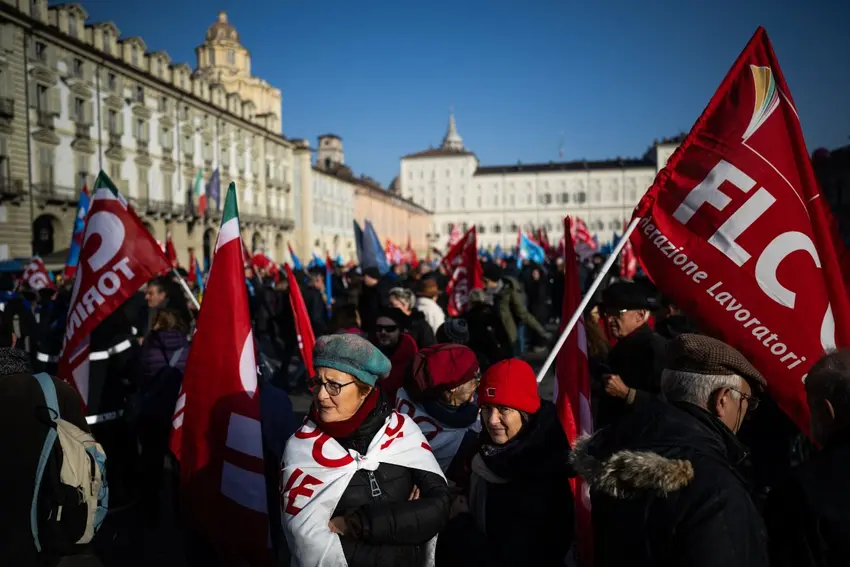
The strike, called by two union confederations, was scheduled to last eight hours in all sectors except transport, where Transport Minister Matteo Salvini ordered it halved to four hours.
The country's main unions – the left-wing CGIL and the centrist UIL – called the strike in protest against a draft 2025 budget plan tabled by Prime Minister Giorgia Meloni's government, calling it "totally unsuitable to resolve the country's problems".
Workers want to see "an increase in purchasing power for employees and retired people, as well as funding for health, education, public services and industrial policies," the CGIL said in a statement.
Italy, like France, has been singled out by the European Union for its huge deficit.
It is under intense pressure to balance the books and slash its huge public debt, which is currently hovering at around three trillion euros.
Meloni's government has committed to reducing the public deficit to 2.8 percent of gross domestic product from 2026 – below the ceiling of three percent of GDP set by the European Union.
The tough target will require cuts in tax rebates and budget cuts for many ministries and public services.
READ ALSO: How is Italy's general strike affecting daily life on Friday?
Italy's second-largest union, the centre-right CSIL, did not take part in the strike.
CSIL boss Luigi Sbarra on Thursday called it a "sterile, demagogic, populist protest" at a time when the draft budget has not yet been finalised.
The eight-hour stoppage affected numerous private and public sectors, including education, industry, healthcare, post office services and courts.
The strike for bus, metro and tram services lasted just four hours – from 9am to 1pm.
The protest's shorter length was ordered by Salvini under a law that limits strike time to maintain minimum service.
National airline ITA cancelled 109 flights on Friday, including 18 international ones, while Ryanair cancelled "a small number of flights".
Thousands of people demonstrated in Rome, Milan, Naples, Bologna and Palermo.
"The government has betrayed everything it told its voters," in particular that "it would improve the conditions of workers," CGIL's Daniele Canti told AFPTV at a demonstration in the capital.
Train transport was not affected by the strike as rail workers walked out over the weekend and Italian law prevents them from striking again for at least 12 days.
Comments