
Inside Italy is our weekly look at some of the news, talking points and gossip from Italy that you might not have heard about. It’s published each Saturday and members can receive it directly to their inbox, by going to their newsletter preferences or adding their email to the sign-up box in this article.
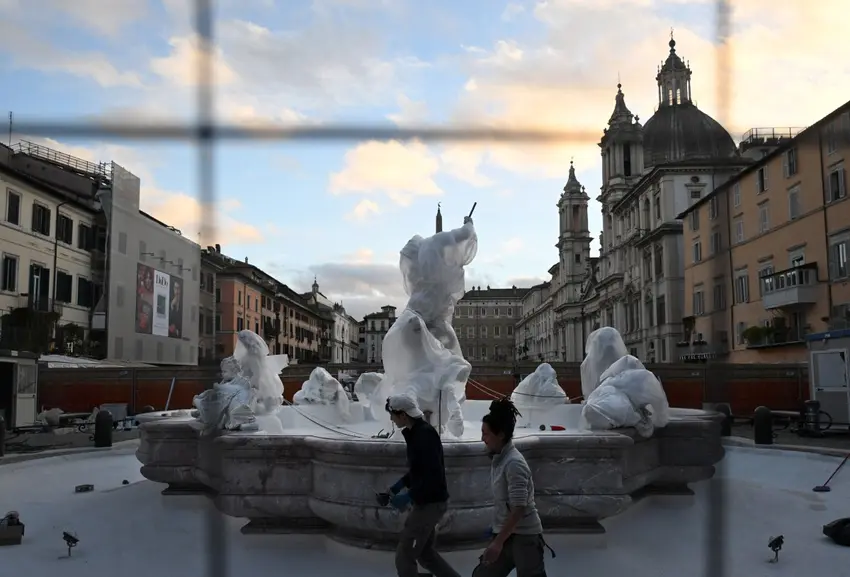
From metro stations to historical buildings and monuments, many parts of Rome are currently undergoing extensive renovation work ahead of the 2025 Jubilee Year, when the capital is expected to see an influx of nearly 35 million visitors.
But with less than a month to go until Pope Francis officially launches Jubilee celebrations by opening the Holy Door of St Peter's Basilica on December 24th, preparations around the city seem far from complete.
A number of key city landmarks, including the iconic Trevi Fountain, are still covered by scaffolding or plastic sheeting, as teams of specialists toil away at cleaning centuries-old marble.
Meanwhile, plenty of cobbled streets and pavements across the historic centre are being redone, with traffic jams frequently forming around diversions during peak commute hours.
In recent months, both national and international media have reported on visitors’ disappointment at finding some of the capital’s most famous attractions fully or partly hidden, with many labelling the city “an open-air construction site”.
But news outlets’ focus this week shifted to a more pressing matter – will Rome actually be able to complete its ‘facelift’ by the start of the Jubilee?
Rome Mayor Roberto Gualtieri has recently said that “all of the Jubilee projects are on schedule,” adding that, of the 204 projects deemed "essential and non-deferrable", 64 will be completed by the start of December.
Barring some of the bigger renovation works however (for instance, the ‘new’ Piazza Pia is expected to be inaugurated on December 20th), there currently isn’t a publicly available timeline outlining when the remaining projects will (or should) be completed by.
Many have recently taken to social media to express doubt over the completion of the planned works by their due date.
One X user said he feared “an abysmal delay in the delivery of the completed works”.
Another was markedly more pessimistic, saying: “I was in Rome recently and I wondered how it would be possible to close all those construction sites in time for the start of the Jubilee. The answer was very simple: they will not close them in time.”
As always, time will tell (or, if you prefer the Italian version, solo il tempo dirà) whether these concerns are indeed justified or not.
Given Italy’s recent track record in preparing major international events (see the delays for Expo 2015 in Milan), I personally find it very hard to believe all projects in Rome will be done and dusted by the end of the year.
But then again, I suspect that, as an Italian, a generous dose of pessimism was naturally embedded in my DNA sequencing at birth…and I’d be glad to be proved wrong.
Should dialects be taught in Italian schools?
It may be a common scenario in your part of the country: you’re at the local cafe sipping on your frothy morning cappuccino and savouring a cornetto when you suddenly get the feeling that some of the Italian customers around you aren't actually speaking Italian at all.
Well, that may be because they aren’t.
From Veneto to Sicily, every corner of the peninsula has its own regional dialect, though ‘dialect’ isn't always the most accurate term to describe them since many dialetti have evolved separately from modern-day Italian and are in fact languages of their own.
Though dialects were once preferred by locals over ‘standard’ Italian, even in formal settings, their usage has decreased dramatically over the past few decades, with only 14 percent of people still speaking their regional language at home, according to Istat.
And in some parts of the country, dialects have all but completely died out.
I’m frequently reminded of that here in Milan, where local friends and acquaintances tend to be genuinely surprised by the fact that I’m fluent in my own dialect – Venetian.
I’m often told that “no one speaks the Milanese dialect anymore” and the way this is uttered sometimes suggests that knowing the local language may be somewhat undesirable – as though it was some old, outdated piece of furniture that no one cares about anymore.
But I regularly find myself thinking that knowing your own local dialect should be seen as anything but undesirable.
Italian dialects are some of the most valuable parts of the country’s identity. They show the diversity and richness of Italy's linguistic background, and offer a window into its history (especially how Italy as a nation was born out of a multitude of independent states, each having its own customs, language and culture).
That’s why I’ve long held the belief that school authorities around the country should at the very least promote and offer the teaching of local dialects for those who may be willing to take it up.
There have been some experiments on this front in the past few years, with some schools in Sicily and Sardinia introducing optional ‘dialect lessons’ for children.
It’s my sincere hope that initiatives of this kind will soon be extended to other regions across the country.
Dialects are disappearing and, if we lose them, a huge part of Italy’s cultural heritage will go with them.
Inside Italy is our weekly look at some of the news and talking points in Italy that you might not have heard about. It’s published each Saturday and members can receive it directly to their inbox by going to their newsletter preferences or adding their email to the sign-up box in this article.
Comments (1)