
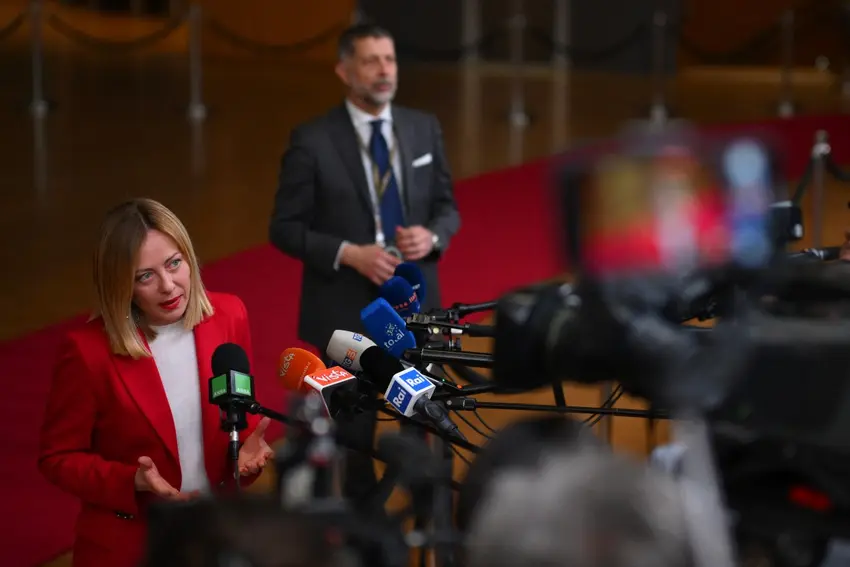
Italy to reach 2-percent defence spending target this year
Italy will increase its defence spending to reach NATO’s target of 2 percent of gross domestic product (GDP) this year, Prime Minister Giorgia Meloni said on Wednesday, according to Ansa.
Rome “will finally reach the target,” Meloni told lawmakers, adding that “Italy and Europe must strengthen their defence capabilities to fulfil the responsibilities they’re faced with”.
“Freedom comes at a price,” she noted.
The Italian premier also said that the target would be reached through higher defence expenditure, as well as the reclassification of certain expenses as defence costs.
According to NATO figures, Italy's defence budget was 1.49 percent of GDP in 2024 – among the lowest within the 32-member alliance.
Meloni’s announcement on Wednesday came less than a month after Deputy PM Antonio Tajani said that Rome intended to raise its defence spending in the coming years as “a direct response to calls from the United States”.
“When they say they can’t be the only ones responsible for Europe’s security, they are right,” Tajani added.
Since taking office in January, US President Donald Trump has repeatedly urged NATO allies to increase military spending as high as 5 percent of GDP amid growing geopolitical tensions.
In response to Trump’s calls, the EU said in March that it would allow member states to raise defence spending by 1.5 percent of GDP each year for four years, without them facing any of the disciplinary procedures that normally kick in after national deficit exceeds 3 percent of GDP.
16 EU countries intend to trigger the emergency clause, according to the latest media reports. Italy isn’t among them.
Black smoke emerges as cardinals fail to elect new pope on first try
Thick black smoke emerged from the chimney of the Vatican's Sistine Chapel on Wednesday evening in a sign that cardinals failed to elect a new head of the Catholic Church in their first conclave vote.
Thousands of people gathered in St Peter's Square to await the announcement, which came around three hours and 15 minutes after the 133 cardinal electors entered the chapel.
Cardinals withdrew to the Santa Marta guesthouse following the first voting session.
They were set to attend a private mass early on Thursday before resuming secret discussions and voting.
Hailing from around 70 countries, the prelates were called to Rome following the death of Pope Francis, who led the world's 1.4 billion Catholics for 12 years.
Under a centuries-old ritual, only cardinals under the age of 80 can take part in the conclave.
Two rounds of voting are held each day until one of the candidates secures a two-thirds majority.
Though around 80 percent of cardinal electors were appointed by Francis, there is no clear frontrunner to succeed the Argentine.
While some cardinals have said they favour a leader capable of protecting and developing Francis’s legacy, others appear to prefer a more conservative defender of the Church’s doctrine.
More than a dozen names have been tipped as favourites by experts – from Italy’s Pietro Parolin to Hungary's Peter Erdo and the Philippines’ Luis Tagle.
UK open to 'sensible' EU youth mobility scheme
The UK government said on Wednesday that it was willing to consider a youth mobility scheme as part of a deal to deepen post-Brexit ties with the European Union.
The comments appeared to signal a marked shift after PM Keir Starmer's government spent months rejecting the idea, which was first broached by the EU last year.
Starmer's spokesman told reporters that Britain would listen to "sensible" proposals from the 27-nation bloc as long as they do not breach the government's red lines for negotiations with Brussels.
"We are always open to listening to sensible proposals from the EU, but they have to be within the framework we have set out," the spokesman said.
"We've always been clear that that framework involves no return to free movement and no return to the single market or the customs union, no return to the EU," he added.
Starmer is reportedly seeking closer ties with Europe to boost flagging economic growth but is also under pressure to reduce migration, as highlighted by the hard-right Reform UK's gains in local elections last week.
The European Union is keen on a scheme that would allow European citizens aged 18 to 30 to study and work in the UK and vice versa.
British government sources have said that ruling out a return to free movement does not prevent "controlled schemes" from being considered, noting that Britain already has youth mobility schemes with 13 non-EU countries.
The UK government has not provided details on how a potential scheme with the EU might work in practice, though experts believe that it would be time-limited and feature a cap on the number of participants.
More than 60 Labour MPs have called on Starmer to agree to a youth mobility scheme but the proposal is likely to face opposition from MPs in seats where Reform is popular.
With reporting from AFP.
Comments