
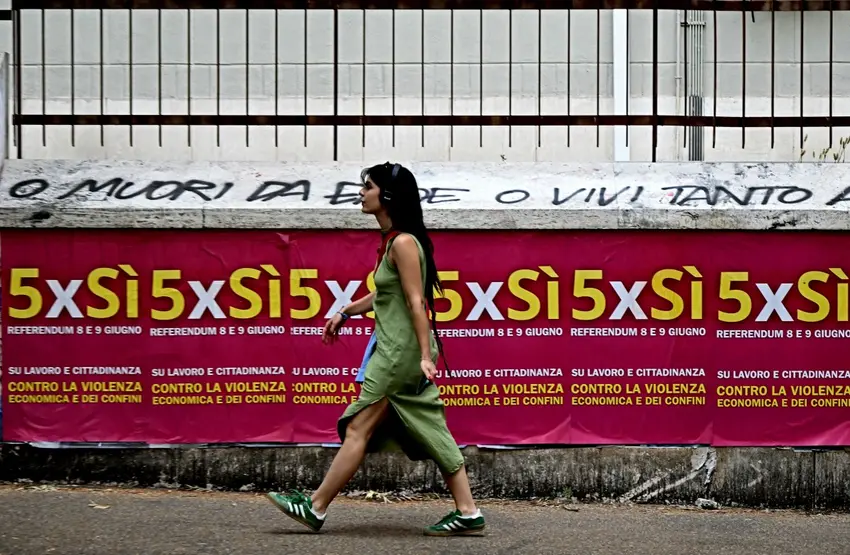
The five proposals on the ballot were not expected to pass, in light of low turnout and the requirement that over 50 percent of voters participate to validate the referendum.
Under current laws, non-EU residents without marriage or blood ties to Italy must live in the country for 10 years before they can apply for citizenship – a process which can then take years.
The proposed reform, which was championed by a grassroots campaign led by centrist party +Europa, would cut this down to five years, aligning Italy with countries like Germany, France and the UK.
According to estimates from immigration research centre Idos, over 1.4 million non-EU nationals would become eligible for Italian citizenship if the referendum were to pass.
Prime Minister Giorgia Meloni is strongly against the citizenship reform.
READ ALSO:
A two-minute guide to Italy's citizenship referendum
Italy’s citizenship vote: When will we know the result?
Do I have to vote in all five of Italy's upcoming referendums?
She said on Thursday that the current citizenship system is "excellent and also very inclusive", adding that Italy has long been “among the European countries that grant the highest number of citizenships every year".
Low initial turnout
More than 213,500 people acquired Italian citizenship in 2023, around one fifth of the European Union total, according to EU statistics.
Over 90 percent of new citizens were from outside the bloc, mostly from Albania and Morocco.
Meloni and her coalition partners have encouraged voters to boycott the referendum, which will only be valid if over 50 percent of eligible voters participate.
At midday Sunday, national participation stood at 7.41 percent, according to the interior ministry. Voting was to continue through to Monday afternoon.
Casting a ballot for the first time in his life at a Rome polling station was Giovanni Puccini, 18, who called Meloni's instruction to abstain "disrespectful" of past sacrifices by Italians.
"You have to vote because in the past so many people fought, even died, for this right," he said.
His friend Pierre Donadio, 21, said less stringent citizenship laws were needed in the country, to boost diversity and avoid "being too closed up in itself".
Even if passed, the reform would not affect a contested law under which children born in Italy to foreign parents cannot claim Italian citizenship until they turn 18.
Workers' rights
Under Italy's constitution, a referendum can be triggered by a petition signed by at least 500,000 voters.
This week's ballot includes one question on citizenship and four others on increasing protections for workers who are dismissed, in precarious situations or involved in workplace accidents.
The changes are being pushed by the left-wing CGIL trade union.
"We want to reverse a culture that has prioritised the interests of business over those of workers," CGIL secretary Maurizio Landini told AFP.
The centre-left Democratic Party is also backing the proposed reforms – even though it introduced some of the laws the CGIL wants to repeal.
The proposals aim to revoke parts of the so-called Jobs Act, a controversial bill passed in 2014 by then Prime Minister Matteo Renzi under plans to liberalise Italy's labour market.
Supporters of the bill say it boosted employment across the country, while detractors say it made work more precarious.
Under new leadership, the Democratic Party -- which is polling behind Meloni's Brothers of Italy -- is seeking to woo working-class voters by backing the referendum reform.
Comments