
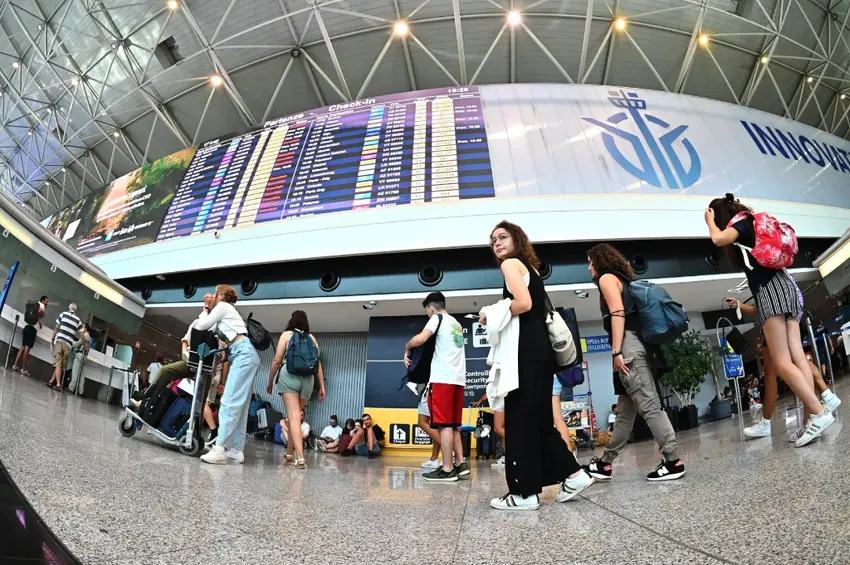
Rome Fiumicino rated 'best airport' in Europe
Rome’s Fiumicino Airport has been rated Europe’s best in the Over 40 Million Passengers category for the seventh time since 2018 by the Airports Council International (ACI).
The ACI, which ranks European airports based on quality markers including passenger experience, safety, technological innovation and environmental sustainability, praised Fiumicino for “its continued commitment to excellence” in a press release.
Judges cited the airport’s “data‑driven approach to management” and environmental efforts, including the launch of “Europe’s largest self‑consumption solar farm”, among the reasons behind the prestigious recognition.
Marco Troncone, the CEO of Fiumicino manager Aeroporti di Roma (AdR), said the award consolidated the airport’s “European leadership”, encouraging staff to “maintain those levels of excellence that now position us also on a global level".
“We are seeing strong growth in traffic to our country, which makes the future promising,” Troncone added.
In the first five months of 2025, Fiumicino recorded a passenger traffic increase of seven percent compared to the same period in 2024, according to AdR.
Fiumicino is Italy’s largest airport and is among the major gateways to the country for long-haul travellers.
Italy delays contested tax on sugary drinks - again
A contested tax on sugary drinks will not come into force on Tuesday, July 1st after the Italian government postponed its implementation to December 31st, according to Il Sole 24 Ore.
The levy was originally due to come into effect in early 2020, but fierce protests from soft drink producers persuaded successive Italian administrations to repeatedly delay its enforcement.
The measure, which is intended to address health issues such as obesity and diabetes and reduce the burden these conditions place on the national healthcare system, includes a €0.10 tax on every litre of sugar-sweetened beverages such as sodas (Coca-Cola, Fanta, Sprite, etc.), sweet teas and energy drinks.
If implemented, the tax would lead to price hikes of up to 25 percent on sugary drinks, according to estimates from Il Sole 24 Ore.
Italy’s ruling coalition has long opposed the so-called ‘sugar tax’.
Maurizio Gasparri, an MP from the centre-right Forza Italia party, said on Friday that the levy was “pointless”, adding that it would “end up doing more harm than good to the state’s finances”.
Italian business lobby group Coldiretti has also criticised the tax, arguing that it would undermine the country’s agri-food sector “at a time of difficulty caused by a complex international situation".
If enforced, the levy would threaten the survival of hundreds of small businesses in southern Italy, putting nearly 5,000 jobs at risk, Coldiretti added.
Italy cracks down on violence against sports referees
Referees in Italy have been granted the same legal status as police officers and other public officials in a bid to curb a rise in cases of assault in sports including football, Italian Sports Minister Andrea Abodi announced on Friday.
Under an amendment to Italy’s penal code approved by cabinet ministers last week, players committing acts of violence against match officials will now face tougher penalties, including prison sentences for the most serious offences.
The move comes after months of discussions between the government and the Italian Referees Association (AIA) over a spike in cases of abuse and assault against match officials, especially in football.
In one notorious example, 19-year-old referee Diego Alfonzetti was attacked by multiple players while officiating a youth football match in Riposto, Sicily, in early April.
He was later invited onto the pitch before the Lazio-Roma Serie A derby on April 14th as an act of solidarity.
Antonio Zappi, the head of the Italian Referees Association, hailed the law change as “historic”, stressing that violence against match officials had long become a “social emergency”.
Comments