
Thoughts of carnevale in Italy conjure images of luxurious masquerade balls in Venetian palaces, but Venice isn’t the only place that knows how to throw a carnival party.
You’ll find similar festivities, from traditional masks and parades to specialty fritters, across Italy.
But you’ll also encounter carnivals with their own distinct identity shaped by local and regional history and culture. In the medieval Marche town of Offida, carnevale is synonymous with simple red and white costumes and a bull fight. Meanwhile, this time of year is all about the ancient Sa Sartiglia horse race in the coastal Sardinian town of Oristano.
Though the many Italian carnival celebrations are too many to count, these are some of the more unique or well-known.
The dates listed below are when you'll be able to see the main events, but most carnivals will also host a range of related events throughout the month of February. Check out the programmes below for more details.
READ ALSO: Venice Carnival: What to expect if you're visiting in 2026
Acireale (Catania) – January 31st; February 1st, 6th-8th, 12th-17th
Acireale’s festivities once involved locals throwing rotten eggs, oranges and lemons at each other in the street. Luckily for 21st century visitors, the custom was banned in 1612.
These days, the local carnival on the eastern Sicilian coast is a much more respectable affair: besides papier-mâché caricatures of public figures, you can expect to see elaborate flower and light displays.
If you miss the February festivities, Acireale's carnival is so popular it usually returns for a few weeks in July and August.
More information here.
Cento (Ferrara) – February 1st, 8th, 15th, 22nd; March 1st
This quiet medieval town in the Emilia Romagna countryside comes to life when it puts on its 'Carnival of Europe' festival. Since the early 90s, it's been twinned with Rio de Janeiro's carnival, with the winning floats later appearing in the Rio parade.
Watch out for flying objects – part of Cento's tradition is the gettito, where toys and inflatable objects are thrown from the floats into the crowd. The end of the festival is marked with a fireworks show.
More information here.
Fano (Pesaro and Urbino) – February 1st, 8th, 15th
Fano's is the sweetest of all the festivals, as chocolates, treats and sugared almonds are thrown from the float wagons into the crowds of spectators.
The festival dates to 1347, making it one of Italy's oldest carnivals, and is thought to have originated as a celebration of the reconciliation between two warring local families.
If you prefer sweet spectacles to tastes, in the last parade the floats are traditionally lit up with luminarie, making them particularly impressive to look at.
More information here.
Ivrea (Turin) – February 1st, 8th, 12th, 14th-18th
Looking for something more exciting than your average parade? In Ivrea, the highlight of the festivities is the annual orange fight – a rather messy way of commemorating the local people's struggle against the city's tyrant and, later, against Napoleonic troops.
Those on foot represent the townspeople, while those on carts play the part of the troops, all throwing oranges at each other.
READ ALSO: Why does the Italian town of Ivrea hold a ‘battle of the oranges’?
The epic battle lasts three days – this year, from February 15th to 17th – at the end of which awards are bestowed on the winning teams.
More information here.
Offida (Ascoli Piceno) – February 1st, 7th-8th, 12th-17th
If you’re looking to be more than a spectator in carnevale events, this carnival in Marche is the right choice. Celebrated for more than 500 years, the Offida Carnival is a folk event of rituals that locals and visitors alike take part in, from a (fake) bullfight to a bonfire.
Even the aesthetic is different from the Venetian style. Carnival-goers in Offida wear white cloths and a traditional mask called the guazzarò trimmed in red.
The carnival officially opens every January 17th (St Anthony’s Day), but the two biggest events – Lu Bov Fint and Vlurd – take place on Friday, February 13th, and Shrove Tuesday (Feb. 17th), respectively.
More information here.
Ronciglione (Viterbo) – February 1st, 8th, 15th
If you’re near Rome and want to see a really impressive carnevale display, it's worth heading to nearby Ronciglione.
Voted Italy's most beautiful village in 2023, this charming hilltop comune puts on a parade of giant papier-mâché floats. There are also street artists, folk bands and dancing, and, of course, plenty of carnival food.
More information here.
READ ALSO: Chiacchiere, castagnole, graffe: Six of Italy’s most popular carnival sweets
Putignano (Bari) – February 1st, 7th, 15th, 17th
Putignano's carnival is one of Europe's oldest, dating to 1394, when the relics of Saint Stephen were transported to the town to protect them from Saracen raids, and locals joined in the procession.
It’s also one of the longest-running carnivals in Europe, technically starting on Boxing Day and traditionally ending on Shrove Tuesday, when a papier-mâché pig is carried through the streets and then burned. Concerts, shows and various parades all feature.
More information here.
Viareggio (Lucca) – February 1st, 7th, 12th, 15th, 17th, 21st
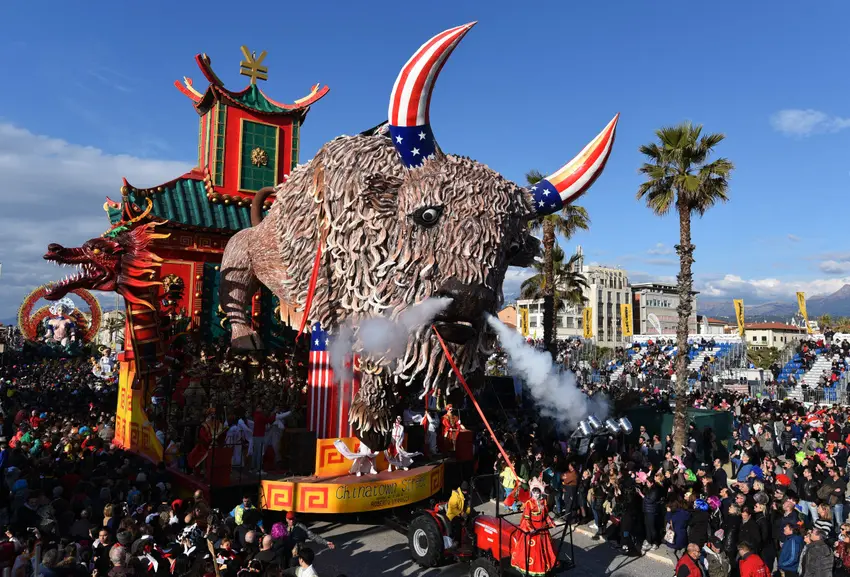
In Viareggio's masked parade, hundreds of colourful papier-mâché floats of up to 70 feet in height are carried along the seafront of the Tuscan town amid music and dancing performances.
The Carnevale di Viareggio started out in 1873 as a protest against the upper classes not having to pay taxes.
To this day, the event continues to provide political and social commentary, so expect to see papier-mâché caricatures of politicians and celebrities atop the carnival floats.
More information is available here.
Tempio Pausania (Sassari) – February 7th, 12th, 14th-17th
Spanning six days, the Carrasciali Timpiesu carnival in Tempio Pausania is one of Sardinia's most important, with cultural roots that date back to ancient times.
It starts with the triumphal entrance of King George, a straw puppet known as Jolgliu Puntogliu. For several days, the king plays a central role in the general festivities and merriment, then on Mardi Gras, he's put on trial for all the town's ills and burned at the stake.
More information here.
READ ALSO: Wine, masks and debauchery: How did Italy’s Carnival tradition begin?
Santhià (Vercelli) – February 10th-17th
This unassuming town in the Piedmont countryside hosts a massive carnevale festival. The historic event features giant floats, music performances and plenty of chances to try local food – like the famous gianduia chocolate spread.
The traditional sfilata (parade) involves 2,000 people with 10 floats and 10 masked groups.
Unmissable parts of the event include the Colossale Fagiuolata, where a traditional dish of beans, salami and lard is served to festival-goers, and the Rogo del Babaciu, the burning of a stuffed figure in the town’s piazza.
More information here.
Verona – February 13th
Italy’s beloved potato-pasta takes centre stage at the Verona carnival, known as the Bacanal del Gnoco. The main event is the parade, the Venerdì Gnocolar, in which plates of gnocchi are handed out.
The event is presided over by Papà del Gnocco, ‘Father Dumpling’, who’s elected by locals and rules with a giant golden fork.
The gnocchi theme is far from random – it’s traditional in Verona and other parts of the region to eat the dish on the last Friday before Lent.
More information here.
Sciacca (Agrigento) – February 14th-15th, 20th-21st, 22nd
Concerts, parades, plenty of food and drink, and a grand ball make up the festivities at this Sicilian extravaganza, which has a friendly rivalry with Acireale.
It's thought to date back to Roman times, and the highlight is on the final day when the chariot of Peppe Napa, the Carnival King, is burned in the town's main square.
More information here.
Imola (Bologna) – February 15th
The Fantaveicoli Carnival in Imola is one of the newer carnivals in Italy, best known for its creative approach to parade floats. The carnival honours innovation and sustainability by encouraging residents of all ages to craft their float from old mechanical parts.
The result is an inspiring scene of upcycled ‘floats’ of all sorts, from those you pedal to solar-powered vehicles.
More information here.
Maiori (Salerno) – February 15th, 17th, 22nd
The Amalfi Coast’s most famous carnival takes place in seaside Maiori, in the shadow of one of the country’s most picturesque landscapes.
Rainbow-hued floats parade along the promenade, accompanied by dancers and music.
The Gran Carnevale Maiorese celebrates its 52nd edition this year. This annual theme is ‘Il Sogno’ (The Dream).
More information here.
Mamoiada (Nuoro) – February 15th-17th
This is not your usual Italian carnival with brightly decorated floats and people in fun masks and costumes.
The ancient celebrations in this Sardinian town are famous for the symbolic figures of the Mamuthones, dressed in black sheepskins, dramatic black masks and giant bells, and the Issohadores, wearing bright colours and carrying lassos.
The figures, representing joy and good tidings, move through the streets in a slow, rhythmic dance as the Issohadores try to ‘catch’ the spectators with their ropes. Locals will also dress up in traditional clothing for the celebrations.
More information here.
Oristano – February 15th, 17th
A truly unique carnival event takes place in Oristano on the west coast of Sardinia.
Sa Sartiglia is an annual horse race in which 100 masked horseback riders compete to see whose sword can capture a star that’s strung in the air. The horses are decorated in flowers and other regalia, and they gallop to the beat of traditional drummers.
Held every Sunday of Lent and Shrove Tuesday since 1546, the game, like its name, is a relic of the four-century period when Spain controlled the island.
More information here.
Comments