
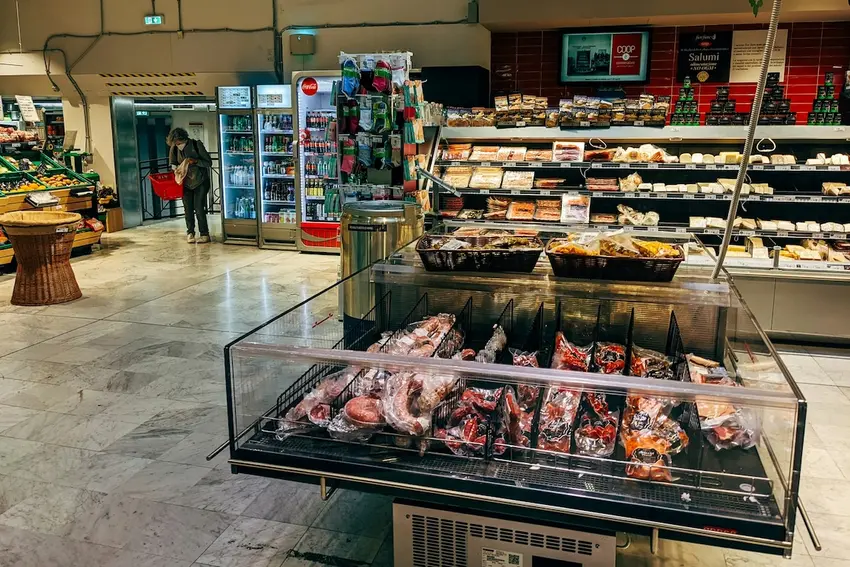
If you’ve had sticker shock upon hearing your total rung up at the supermarket, you should know the exorbitant prices are not just in your head – food costs in Italy have been increasing exponentially in recent years.
Grocery prices have risen by 25 percent since 2021 – nearly eight points higher than the general consumer price index – according to data collected by Istat, the national statistics institute.
READ ALSO: Six key tips to save money on groceries in Italy
Consumer group Codacons estimates that rising prices have added an average of €1,900 to Italian families’ annual food costs in the past five years, leading one in three households to cut back on food expenditures, says Assoutenti, another consumer rights group.
Ten years ago, the average single person in Italy spent about €290 per month at the grocery store – around €58 on meat, €70 on fruits and vegetables, and €9 for coffee and tea, according to Istat.
Despite cost-saving efforts, the amount by which Italian families’ spending at the supermarket has increased in recent years is still far outpacing inflation.
In 2024, the year for which the most recent data is available, a single person spent about €338.50 per month on groceries – or 16 percent more than they did in 2016.
Some items are priced dramatically differently depending on the location.
Codacons’ comparison of 18 Italian cities using data from the national Prices and Tariffs Observatory showed that consumer food costs are highest in the northern cities of Milan and Bolzano and least expensive in southern cities, specifically in Naples, Bari and Catanzaro.
READ ALSO: Is life in Milan really becoming unaffordable?
For example, a cappuccino in Bolzano averages a steep €2.29, which you can get in Rome for about a euro less.
A kilo of tomatoes averages only €2.72 in Naples, whereas the same is more than 40 percent more in Turin at €3.87, and almost double in Bolzano (at around €4.58).
A litre of milk in Milan costs an average of €1.22, €1.11 in Bari, and something in between in Florence (€1.16).
READ ALSO: How much does it cost to live in Rome in 2026?
Italy’s consumer price index, L'Indice Nazionale dei prezzi al consumo per l'Intera Collettività (NIC), reveals which items are being hit hardest by the rising prices.
Watchdog Federconsumatori’s analysis of the index found that the cost of beef products, rice, coffee and chocolate have been on the rise, while olive oil, vegetables and some fruits are either declining in price or holding steady.
The Prices and Tariffs Observatory data, which dates back to 2021, paints a clear picture of just how much these commodities have swelled in price.
In 2021, you could buy a kilo of rice in the Calabrian capital of Catanzaro for about €1.90. Today, that would cost €2.39 – or more than 25 percent.
A Roman doing their shopping in late 2025 spent an average of 26.6 percent more on beef and 44.8 percent more on chocolate than they did four years ago.
Perhaps worst of all, coffee prices have soared – from €9.54 per kilo in 2021 to €17.31 per kilo in 2025. That’s a hike of more than 80 percent.
Consumer rights groups called upon the national antitrust authority to investigate. A probe into large-scale retailers in the agri-food supply chain has been launched and is ongoing.
Comments