
Avoid illegal taxis
If you're travelling from an airport, both of Rome's airports have official taxi stands with staff directing passengers into the next available car.
However you may see unofficial "taxi drivers" hang around airports, train stations and major tourist attractions, trying to pick up customers. Passengers are advised to avoid any offers for a taxi from people waiting at arrivals.
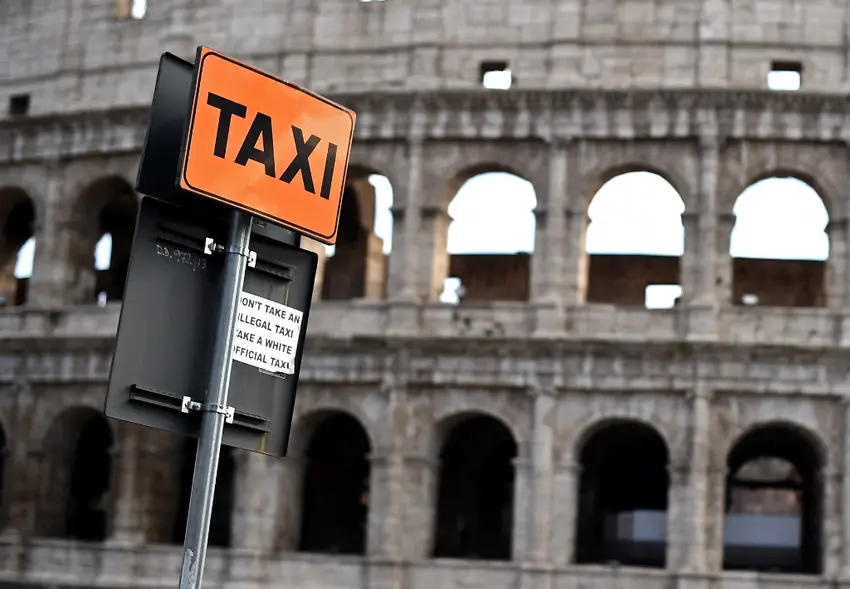
Wherever you are, your best bet for finding a legitimate taxi is to queue up at the nearest taxi stand (marked by an orange sign reading 'taxi'). To find a taxi stand, you can search for "posteggio taxi" in your maps app.
You can't really hail a taxi on the street as you would in New York, so if you need to order a taxi to come directly to you, you should use a ride-hailing app. The most commonly used are itTaxi and FreeNow, both of which are available in English.
Rome also has a city-owned app called "Call Taxi" ("Chiama Taxi"). If you prefer, you can also place a phone call to the city's taxi booking hotline at 060609. They claim that you can get a taxi faster and for cheaper by using their number or app, though I don't know if that's true.
Uber technically does work in Rome and Milan, but it is only able to order an Uber Black or hail a regular taxi. Uber in its original form does not exist in Italy.
Another private airport transport option is a private chauffeur service, which is arranged ahead of time. You can find these companies online and get a quote – it's usually not much different than the cost of a taxi. The driver waits at arrivals holding a sign with your name and escorts you to their car. They also have your flight number, so they can track you if there's a delay.
These car hires are a good option if you're traveling in a large group and/or with a lot of luggage, since the private cars are usually large vans.
Identifying an official taxi
Thankfully, official taxis in Rome are pretty obvious. They are always white and have a sign on top that reads “Taxi”.
They also have the license plate number written on the doors, the rear, and inside the vehicle. If you hailed the taxi from an app, your driver's name and license plate number will appear. When the taxi arrives, it's best to confirm that the license plate written on the door of the car matches the one written on your app for safety reasons. I also ask the driver to confirm my name, to make sure I don't get in the wrong taxi (believe me, it does happen!).
Once inside the car, you will see a meter in the front of the car. Make sure that it is turned on and running if you're not taking a fixed-fare route (i.e., to or from the airport).
READ ALSO: Are scams really a big problem in Italy?
Know the rate
Even though you aren't likely to face any would-be scams in official taxis, it's still better to know what to expect when you go to pay so there's no doubt or confusion.
Fixed rate to Rome's airports
The cost of a taxi ride to and from Rome's airports is a fixed rate as long as you're within the city walls (mura aureliane). This includes the touristic parts of the city, including the centre.
If you're flying in or out of Rome's main airport (Fiumicino–FCO), the rate is €55. If your destination isn't inside the city walls but within the Grande Raccordo Anulare – the large ring road that encircles the city – it will be a minimum of €35 and a maximum of €80.
To or from Rome's smaller Ciampino airport (CIA), the fixed fare is €40 within the city walls. If your destination isn't inside the city walls, it will be a minimum of at least €25.
READ ALSO: EXPLAINED: How you can travel in Italy when there's a transport strike
Metered rides within the city
If you're simply taking a taxi within Rome, from your hotel to dinner, for example, your fare will be based on the taxi meter. Important to note is the somewhat recent change that raised the minimum taxi fare to €9, no matter how long the ride.
There is also a €5 fee added when you order a taxi to come directly to you (rather than finding one yourself at a taxi stand).
Unlike in cities such as New York and Paris, taxis in Rome do not use surge or dynamic pricing.
The flag-drop fare or starting fee – which is charged the moment you begin your trip – is only based on the day of week and time of day, not extraneous factors like demand or weather. The starting fee is €3 on weekdays from 6am to 10pm (the same is €5 on weekends and holidays) or €7.50 for rides taking place at night between 10pm and 6am.
READ ALSO: The new (and old) rules for riding an electric scooter in Italy
You can get a discount of 10 to 15 percent for a variety of reasons, including if you're a single woman needing a ride at night or if you need to go to the hospital.
One piece of luggage and up to four people are included in the price, but there are surcharges of €1 per bag and €5 per person for any additional bags or passengers.
Other useful information
It is up to you if you want to tip, but you'll have to do so in cash. A tip isn't automatically added to the bill, and you usually won't be able to add one onto your credit card charge.
All taxis must accept payment by card, according to municipal regulations. However it's not uncommon to hear a driver say their card reader isn't working in an attempt to get paid in cash.
If you lose an item in a taxi or want to file a complaint, check this website for info on who to contact.
Comments