
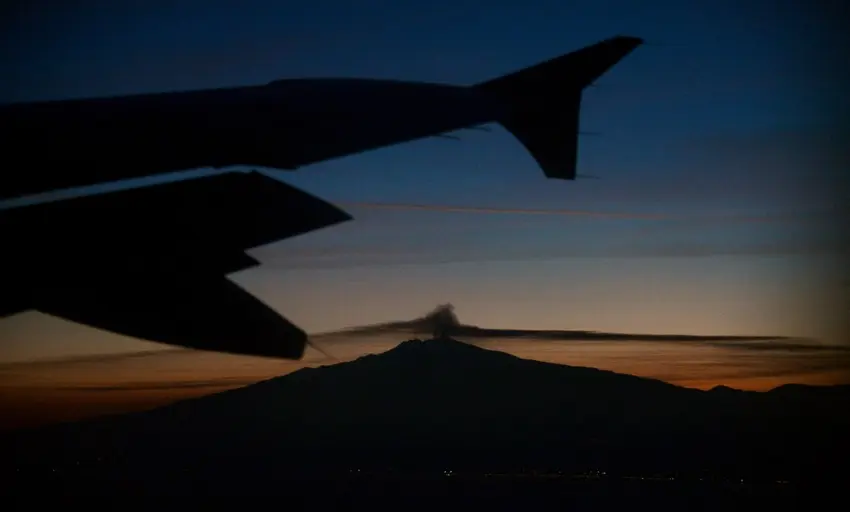
Two of Italy’s active volcanos have blown their tops this summer, with both Etna and Stromboli spewing hot lava and embers into Sicily's skies in recent weeks.
The towering Mount Etna, Europe's largest active volcano, erupted in a fiery display in the early hours of Sunday, August 4th.
The resulting thick layers of ash forced the nearby Catania airport to limit the number of inbound flights to six per hour and close an entire section of the hub on Sunday morning.
Forte #eruzione dell’Etna questa mattina#Etna #vulcano #Sicilia #Italia
— Val Anton - it (@citiesval) August 4, 2024
4/8/24 pic.twitter.com/qxxAhXufvA
All restrictions were lifted by late Sunday afternoon, but airport management warned passengers of possible knock-on delays and cancellations as a result of previous measures.
The Stromboli volcano, on a tiny volcanic island in the Aeolian archipelago, off the northern coast of Sicily, has also been active this summer.
Stromboli erupted for the first time since 2022 on Friday, July 5th, with streams of lava reported to have reached the sea.
This was followed by another powerful eruption on Thursday, July 11th, which resulted in local authorities asking tourists to temporarily leave the island’s beaches.
Should you be worried about travelling to Sicily this summer?
Following recent eruptions, visitors with upcoming trips may be understandably concerned about how volcanic activity on the island might affect their plans.
The first thing to keep in mind is that eruptions of these two volcanoes are nothing new to residents. Sicilians have been dealing with volcanic rumblings since as far back as 425 BCE.
Mount Etna dominates the eastern part of the island, which is home to more than 25 percent of Sicily's population. Designated as a UNESCO World Heritage site in 2013, it regularly emits plumes of ash and cascading rivers of lava.
Stromboli is known for being one of the most active volcanoes in the world, according to Italy’s National Institute of Geophysics and Volcanology (INGV).
The 926-metre-high volcano has been erupting on a regular basis for the last 90 years. That said, the INGV generally considers Strombolian activity a low-level type of eruption, which, on average, 'only' releases a relatively modest amount of energy.
Alle 14.08 del #11luglio un'esplosione parossistica ha interessato #Stromboli. Nel video è ben visibile la colonna eruttiva di un’altezza di circa 4/5km. La ricaduta di cenere non ha interessato in modo rilevante gli abitati di Ginostra e Stromboli. pic.twitter.com/BNWCn5w2kL
— Dipartimento Protezione Civile (@DPCgov) July 12, 2024
Prior to the latest eruptions, the last time Stromboli had erupted was in 2022, with no casualties reported. Prior to that, a 2019 explosion had claimed the life of a hiker, who was reportedly struck by a piece of molten rock.
READ ALSO: Where are Italy's active volcanoes and how dangerous are they?
Despite these flare-ups, Stromboli – made famous by the 1950 film by Italian director Roberto Rossellini – continues to be a popular destination for tourists, with thousands of visitors arriving by boat each day.
Powerful explosions can create risky conditions in the upper part of the mountain and, to a lesser degree, in the two inhabited centres of Stromboli and Ginostra, situated in the north-eastern and south-western regions respectively.
The island has an acoustic warning system that is activated in the event of an impending eruption (two tones) or tsunami (one tone).
How are flights affected by volcanic activity?
Airport closures due to volcanic activity are not uncommon in Sicily.
Catania’s Vincenzo Bellini airport has completely halted or reduced flights multiple times this summer due to clouds of ash in its airspace. The last airport closure happened on Tuesday, July 23rd, but inbound flights were reduced last Sunday following a gush of volcanic lava and smoke from Mount Etna.
Given that Catania’s airport is closest to the ‘epicentre’ of volcanic activity, it is far more likely to be affected by closures than others in the region.
Flights to Catania's Vincenzo Bellini, Sicily’s busiest airport, are usually diverted to Palermo’s Falcone-Borsellino airport (a four-hour drive away) or Trapani's Vincenzo Florio in the event of closures.
But it is not just air transportation that can be disrupted by the effects of a volcano.
Ground transportation services (trains and buses) can be thwarted temporarily due to poor visibility from ashfall, especially when coupled with rainfall, which can cause slippery conditions on the roads near the volcano.
Worsening air quality is also a risk for individuals with chronic breathing issues such as asthma or COPD.
During periods of ashfall, officials advise limiting exposure, at least until the air has cleared.
If you are planning to travel to affected areas of the island, you can find up-to-the-minute alerts on volcanic activity from the INGV here.
Comments