
The winter holidays are a big deal in Italy, and there's a whole festive lexicon that goes with them.
Here are some words and phrases you'll want to learn in order to celebrate Christmas (and the New Year) like an Italian.
Wishing someone a Merry Christmas or Happy New Year
If you want to spread some Christmas cheer or wish someone a happy New Year, you’ll want to use one of these phrases. You’ll definitely hear them thrown around throughout the season, even amongst strangers.
Buon Natale – Merry Christmas
Buone Feste – Happy Holidays
Buon Anno – Happy New Year
Auguri – Best wishes / Cheers
Natale
Let’s start with the obvious – you can’t have an Italian Christmas without knowing the word for Christmas itself: Natale.
It comes, as you might guess, from the Latin word for ‘birth, in reference to the birth of Jesus.
With Natale comes a number of related words. There’s Babbo Natale, Father Christmas; l’albero di Natale, a Christmas tree; cena di Natale, Christmas dinner; biglietti di Natale, Christmas cards; luci di Natale, Christmas lights; and la messa di Natale, Christmas mass.
When used as an adjective, natale becomes natalizio/ia/i/ie; so addobbi natalizi are Christmas decorations.
READ ALSO: Christmas calendar: All the Italian holiday traditions you won’t want to miss
Novena
The nine-day period before Christmas is known as the Novena. This is a religious rite in the Catholic church in which there are nine successive days of prayer leading up to Christmas Day. It's also considered a time set aside to remember the journey of the shepherds to the baby Jesus' manger.
Like many religious practices, the novena has also become a cultural event. In rural areas in particular, children go from house to house dressed as shepherds and performing Christmas songs or poems, often in exchange for money or sweets.
Vigilia
A vigilia is the day or night before any given day of the year, so la Vigilia di Natale is of course the night before Christmas, i.e., Christmas Eve.
The evening meal on Christmas Eve is traditionally based on fish (pesce).
READ ALSO: The food and drink you need for an Italian Christmas feast
If you eat at an Italian home or restaurant on this date, you're almost certain to be served a wide array of seafood in various forms.
Eel (anguilla) is one traditional component, while cod (merluzzo), octopus (polpo), prawns (gamberi), oysters (ostriche) and other types of shellfish are all popular choices.
Presepio
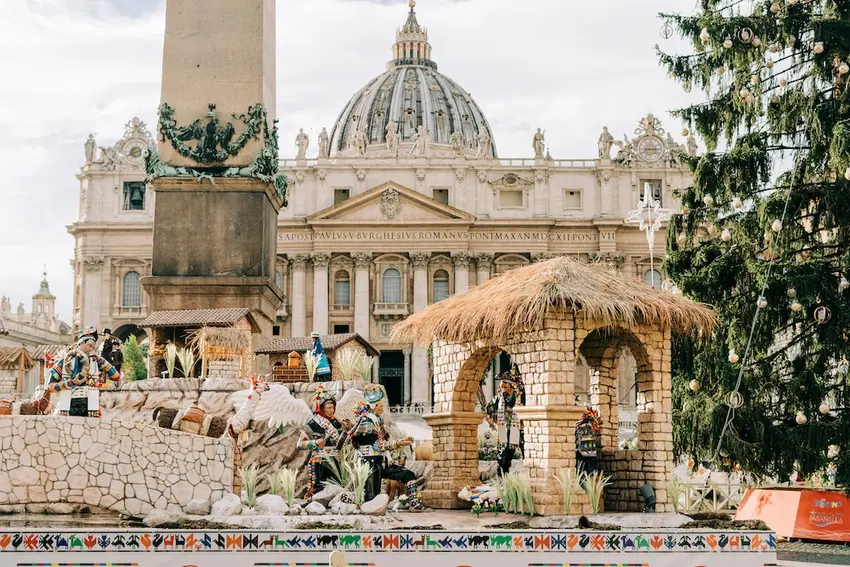
A presepio or presepe (two variations on the original Latin that mean the same thing) is a nativity scene – and few countries put as much effort into their presepi as Italy does.
Whether they’re floating on water, made up of 15,000 lights sprawling across a hillside, or being performed by live actors (a presepe vivente), come Advent (l’Avvento), you’ll find a nativity scene to impress in almost every Italian town and city.
READ ALSO: Italy's best 'presepi': 11 Christmas nativity scenes you need to see
Ceppo
Enter an Italian home around Christmas time, and you’re likely to see an ornate display of gifts (regali) in the shape of a pyramid.
The ceppo is a wooden vertical structure displaying presents amongst candles, greenery, candy, fruit and other decorations.
It’s sometimes considered an ancient ancestor of the modern Christmas tree, and is believed to have started in Tuscany.
The word ‘ceppo’ is sometimes attributed to another Christmas tradition, which in English we know as the Yule Log. In Italy, like other parts of the world, il ceppo di Natale is a log of wood set to burn through the days leading up to Christmas, warming the home and making spirits bright.
It’s a rarely practiced custom these days. Much more popular is indulging in an edible version of the Yule Log – tronchetto di Natale (Bûche de Noël), which is often served on Christmas Day.
Avanzi
Most households that celebrate Christmas around the world can expect to have substantial leftovers come Boxing Day from their Christmas cenone (‘big dinner’), and Italians are no exception.
Leftovers in Italian are avanzi. Your avanzi di Natale may well include lasagne, tortellini, and meats ranging from ox to veal to (possibly, but with no guarantees) roast turkey or chicken.
With any luck, you’ll also find some dolci di Natale – Christmas sweets or desserts, which typically include panettone or pandoro brioche-based cakes – in the pile of leftovers.
Cinepanettone
The word is a mash-up of cinema and panettone, making it the equivalent of 'cinematic Christmas cake'.
It refers to a particularly Italian genre of festive film timed for release over the holidays, usually starring many of the same actors and essentially recycling the same plot: Italians go on vacation to a scenic location, meet other Italians, argue, reconcile. Hilarity ensues.
In tone, they're closer to a Carry On film than a Hallmark romcom, packed with slapstick, double entendres, off-colour jokes and fruity ladies in revealing outfits. Think festive bunga bunga.
Many people can't stand them for that reason, but bad taste or not, they're part of Italian pop culture.
If you're going to sample one this Christmas, start with the mother of all cinepanettoni: Vacanze di Natale ('Christmas Holidays'), the film that started the tradition back in 1983.
READ ALSO: Seven classic films to watch for an Italian Christmas
San Silvestro
In most other countries, New Year's Eve is just New Year's Eve, but in Italy, it's yet another saint's feast day: that of San Silvestro, a pope about whom little is known beyond the fact that he died on December 31st.
Italians celebrate San Silvestro in much the same way as everyone else around the world: with New Year's Eve parties (veglioni di Capodanno), fireworks (fuochi d'artificio), counting down to midnight (fare il conto alla rovescia) and toasts (brindisi) when it arrives.
More local traditions include eating lentils, playing tombola (a kind of bingo), giving and wearing red underwear for luck, and chucking your junk out the window in preparation for new beginnings.
READ ALSO: Why is bingo so popular in Italy at Christmas?
Capodanno
After dancing the night away for San Silvestro, it's time to get your resolutions in order as you wake up to Capodanno – literally, the 'head of the year'.
As in most countries, in Italy this is a public holiday, giving those suffering from the previous night's festivities a chance to recover.
For the hardier amongst us, it's an opportunity to participate in local New Year customs like jumping in the River Tiber, an annual Roman tradition that dates back to 1946.
READ ALSO: Seven can’t-miss New Year’s Eve events in Italy in 2025
Epifania
Christmas in Italy lasts well into the New Year, wrapping up on January 6th, with Epifania, or Epiphany.
That’s when the Three Wise Men finally complete their journey and make it to the stable to find baby Jesus in his crib.
It used to be the day on which Italian children would receive their Christmas presents; these days, that tends to happen on December 24th or 25th, as in the US and UK.
Nonetheless, it’s a public holiday, so children and parents alike still receive the gift of closed schools and a day off work.
Befana
In many parts of the world, Babbo Natale gets all the glory, but not in Italy.
Here, the Christmas witch La Befana hops on her broomstick to distribute presents to boys and girls on the vigilia dell'Epifania, or the eve of Epiphany.
Legend holds that the Three Wise Men came to her house and invited her to join their search for Christ. She was too busy with housework so declined, but later changed her mind, and to this day is still searching for the child, leaving presents for any good children she comes across.
READ ALSO: La Befana: How Italy celebrates a witch on January 6th
Neve
If you’re in northern Italy this Christmas (or even some more mountainous parts of the centre and south), you may be lucky enough to experience neve, or snow.
Like ‘snow’, neve is an uncountable noun, meaning it doesn’t have a singular form in its own right. A fiocco di neve is a snowflake, and a pupazzo di neve is a snowman (literally, a snow doll).
To snow is nevicare, and if you're dreaming of a white Christmas, that's a direct translation into Italian: it's a bianco Natale you're hoping for.
Slitta
Babbo Natale could never make it through all that neve without suitable transport options – he’ll need his trusty sleigh, or slitta driven by his reindeer (renna).
And if your dream of waking up to a bianco Natale comes true and you want to imitate Santa on your own toboggan or sledge, you’ll be climbing into a slittino.
As you might be able to infer from these nouns, the verb slittare means to slide or slip.
While this is very much a physical action engaged in by tobogganers, it can also be used figuratively – you’ll often see it crop up in Italian news headlines, referencing things like parliamentary deadlines being pushed (‘sliding’) back.
Comments