
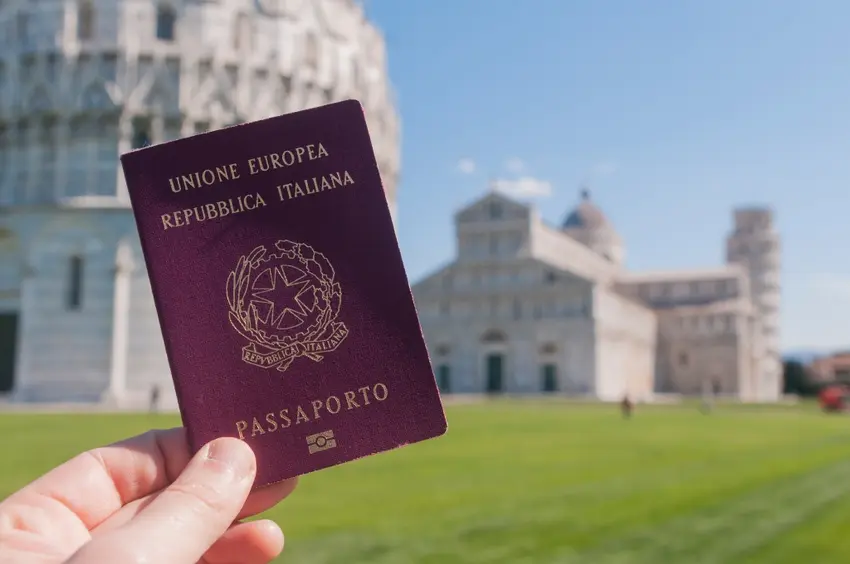
This week in Italy’s parliament, there’s been a lot of discussion of foreign nationals and serious crime – two things which, if you listen to the right-wing parties in power, apparently go hand in hand.
Two bills presented on Wednesday push for naturalised Italians convicted of certain crimes to have their citizenship revoked. Reading the list of qualifying crimes, few would argue that this is too harsh: homicide, human trafficking, female genital mutilation, sexual violence.
Yet in Italy, stripping someone of citizenship is extreme and almost unheard of – I’ve only been able to find reports of it happening twice in the seven years it’s been possible.
The current law allowing citizenship to be stripped from those convicted on terrorism charges was introduced in 2018 by the same political party – the League – now pushing to expand the list further. Brothers of Italy, not wanting to be outdone, put forward its own version of the bill the same afternoon.
I gained Italian citizenship myself last year through marriage, which turned out to be a fairly mechanical business. You gather the documents, sit the language exam, fill out the form, and wait for the wheels of bureaucracy to turn. If you meet the conditions, the state confirms a right, rather than weighing whether it wants you.
The residency route is a different matter. Naturalisation, which for most people means ten years of living here first, is granted with a margin of discretion, so you can meet every requirement and still be turned down with little explanation. It’s no wonder people who reach citizenship this way often describe it as a privilege.
This week’s bills ignore this distinction. Revocation would apply to naturalised Italians, and to those of us who married in, and to the children of immigrants who declare their citizenship at 18 after growing up here. The bill takes these rights and makes them provisional. Meanwhile, someone born in Italy to Italian parents could commit any crime on the list and stay Italian, creating a two-tiered system of citizenship.
Plenty of dual nationals will feel that this bill has nothing to do with them. They're not traffickers or terrorists, and have never had anything worse than a parking fine. But once citizenship can be taken back, the only question left is which crimes count, and that is a line governments tend to move.
League leader Matteo Salvini stated his intentions plainly in May this year. Italian citizenship, he said, “cannot be for life” and should, more like a residency permit, be seen as “an act of trust from the Italian people.”
Italy’s government already has a fraught relationship with would-be citizens. It spent last year blocking thousands from claiming citizenship through ancestry, a change still being fought in the courts. And it already makes the children of immigrants wait until they turn 18 to apply to become citizens, under some of the strictest rules in Europe, despite their having been born and raised and schooled here, and already being Italian by any reasonable measure. The new bill from the League would make it even harder for them to apply, and would mean something as mundane as being involved in a scuffle could block that application indefinitely.
Italy is far from alone in the push to make it easier to revoke citizenship. The government here seems to be chasing the UK and US, both already much further down this bleak path. The British Home Secretary can, as of 2022, strip citizenship from any Brit with dual nationality - like me - if they decide it would be “conducive to the public good.” Whatever that means.
Meanwhile, the Trump administration is pursuing what it calls "denaturalisation," dramatically expanding the criminal cases that can cost naturalised Americans their citizenship a status which until very recently was viewed almost as a sacred institution. It seems intent on widening that net further, including, legal experts warn, to cover speech critical of the administration.
In Italy, we can be grateful that the constitution explicitly blocks the removal of citizenship for political reasons - though nothing guarantees it stays that way.
Sweden, another EU country enthusiastically pursuing a nationalist agenda, has been amending its constitution to let dual nationals be stripped of citizenship, and the grounds for this have already broadened: it began with crimes like terrorism and treason, and the government then pushed to add the far vaguer category of offences that “seriously harm Sweden’s vital interests.” Swedish Green MP Annika Hirvonen, herself a dual citizen, told our colleagues at The Local Sweden as the plans took shape that “opening this door up is a really dangerous path.”
As for why Italy’s government suddenly seems fixated on this topic: there’s a new, more extreme anti-immigrant party on the scene. Roberto Vannacci’s National Future recently overtook the League in the polls on a promise of mass deportations. With a general election next year, none of them wants to look like the soft one.
It's possible that neither of this week’s bills will ever become law. But the argument in favour of revoking citizenship already treats every foreigner as a potential criminal, and normalises the idea that citizenship should not be a democratic right, or even a privilege, but a reward conditional on good behaviour.
Comments (5)