
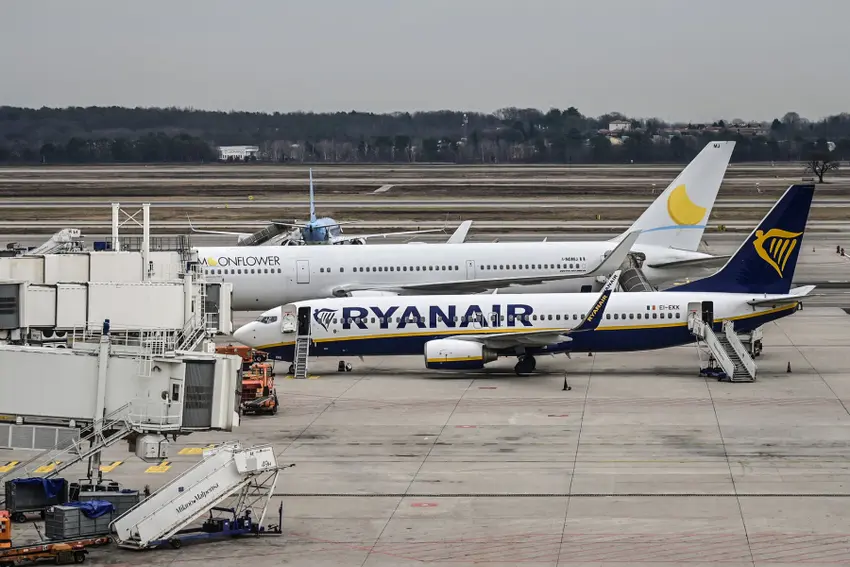
Budget airline Ryanair dealt a blow to Spanish residents and tourists this week by announcing cuts to 36 flight connections with Spain by this winter.
On Monday, September 3rd, Ryanair’s CEO Eddie Wilson held a press conference in Madrid in which he confirmed that the budget airline’s threats to reduce its operations in Spain will indeed be carried out.
This will mean one million fewer passenger seats and 36 fewer flight connections with Spain, following previous cuts to 13 Spain flight routes in early 2025. (Our colleagues in Spain reported which routes will be affected here.)
Ryanair blamed the cuts on a planned increase to airport fees, which it called “excessive,” noting that it made operations at smaller Spanish airports unprofitable.
READ ALSO: New flights and EES: The big changes for travel in Italy this autumn
All of this may sound familiar to people who regularly fly to and from Italy, where Ryanair operates a large share of both international and domestic flights – and where tussles between the airline and government over airport taxes have been a regular feature in the news in recent years.
The airline has repeatedly threatened to cut services to Sicily and elsewhere in disputes over taxes. So could more of Ryanair’s Italian flights be in the crosshairs as Ryanair appears to intensify its Europe-wide campaign against aviation taxes?
The Irish carrier operates some 40 percent of all domestic flights within Italy and carries 34 percent of all passengers, according to the most recent available data, making its route decisions significant for Italian travellers.
In Spain, Ryanair was protesting nationwide airport operator AENA's approved 6.62 percent fee increase, which will reportedly cost airlines €0.68 per passenger and take effect in March 2026.
This is comparable to Italy's €0.50 surcharge from April 2025, though this only applies to major airports (those handling over 10 million passengers annually).
As a direct result of this surcharge, Ryanair said earlier this year it had removed an aircraft from Rome Fiumicino and halted a planned expansion at Rome Ciampino.
But the bigger disputes with Ryanair in Italy revolve around boarding taxes, which amount to between €6.5-€9 per passenger. These vary around the country as they’re set by regional governments.
And in changes to flight offerings since 2024, the Italian regions with lower taxes appear to have been rewarded.
They included Calabria, which gained new routes from Reggio Calabria and Lamezia Terme, including London Stansted, Brussels Charleroi, Milano Malpensa, Pisa, Frankfurt Hahn, and Paris Beauvais.
Abruzzo's five new destinations included Wroclaw, Cagliari, Kaunas, and Valencia, alongside a Milan Malpensa service increased to twice daily.
READ ALSO: What should residents in Italy do once EES passport checks start?
Puglia gained winter routes to Marseille and Tirana from Bari, plus Trieste from Brindisi, though it has lost other routes in recent years, including Bari to Liverpool.
Sicily passengers lost all potential new routes for 2025 after Ryanair refused to expand due to local taxes.
Ryanair said that “the municipal surcharge continues to harm Sicily’s economy,” reducing the competitiveness of the island’s tourist destinations.
The Irish carrier also urged Sicilian authorities to follow Calabria’s example and abolish the tax altogether to “safeguard year-round connections, tourism, and low-cost travel for citizens.”
Sardinia faces similar challenges, with politicians expressing concern about further isolation despite having three international airports.
At the moment, however, Ryanair appears confident that Italy will remain a profitable market.
In fact, Wilson said the country was a key destination for some of the redirected capacity from Spain.
"We have 300 new planes to allocate to competitive airports, and we are taking them to other countries such as Morocco and Italy," he said.
Comments