
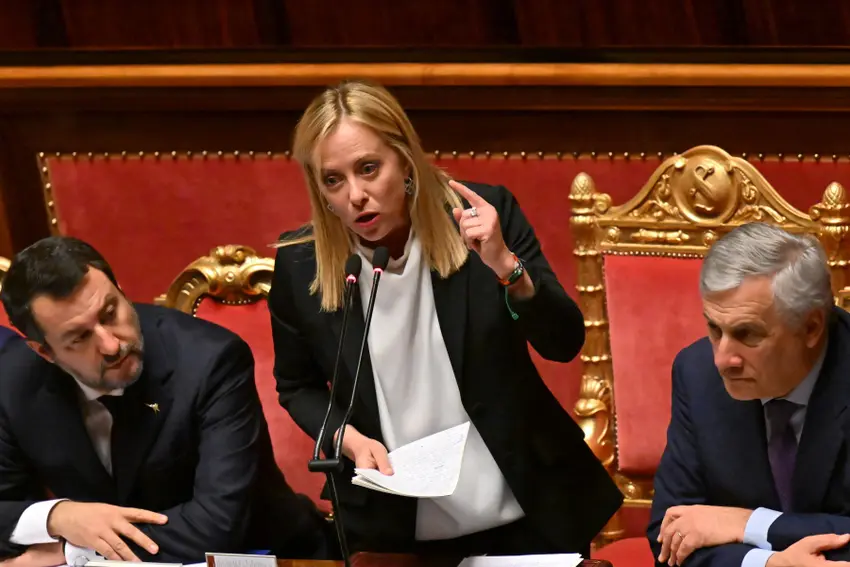
Italy's parliament approved the country's 2025 budget on Saturday, December 28th.
The final go-ahead came at the end of a lengthy parliamentary process, with multiple rounds of amendments pushing the bill's approval close to the December 31st deadline.
The 2025 budget includes measures amounting to a total of €30 billion, with around two-thirds of the sum allocated to tax incentives and bonuses for low- and medium-income households.
Here's an overview of the main changes Italian residents can expect in 2025.
Home renovation bonuses are scaled back – again
Italy’s building ‘bonuses’ – a series of national schemes offering substantial discounts on the cost of home renovation work – have been enormously popular with homeowners since their introduction in 2020.
But some of the major incentives available were scaled back in late 2022 and then in early 2023 following major issues with the tax credit transfer system which stalled countless home renovation projects and pushed tens of thousands of construction companies to the brink of bankruptcy.
Measures included in Italy’s 2025 budget bill will further reduce the maximum claimable discounts under two major bonuses: the ecobonus, which applies to works that improve a property’s energy efficiency, and the sismabonus, applying to works reducing a property’s seismic vulnerability.
READ ALSO: The Italian home renovation bonuses you can still claim in 2025
In 2025, both schemes will offer:
- A 50-percent discount on expenses of up to €96,000 for work carried out in first homes
- A 36-percent discount on expenses of up to €48,000 for work carried out in second homes
The latest budget bill will also lower the discount available under the bonus ristrutturazioni (or ‘renovation bonus’) from 50 to 36 percent of the total cost of work, with the expense ceiling set at €48,000.
For further details on these and other renovation bonuses available to homeowners in 2025, see our separate guide.
Change to Italy’s flat tax for freelancers
First introduced in 2015, Italy’s flat tax scheme (or regime forfettario) is an attractive option for self-employed individuals and small businesses aiming to lower their income tax bills and cut down on red tape.
While Italy’s standard income tax (IRPEF) ranges from 23 to 43 percent of your taxable income depending on your earnings, the flat tax regime allows you to pay five percent of your taxable income for the first five years of business, and 15 percent from there on out.
READ ALSO: Is Italy's flat tax rate for freelancers right for you?
But the scheme has tight eligibility criteria. Among other requirements, it currently cannot be accessed by people who earned more than €30,000 from employment in the previous tax year.
The employment income ceiling will go up to €35,000 in 2025, slightly broadening the pool of people who will be able to access the scheme.
Income tax brackets confirmed
Italy made the switch from a four- to a three-bracket income tax system earlier this year.
IRPEF tax bands are currently organised as follows:
- 23 percent for incomes up to €28,000
- 35 percent for incomes up to €50,000
- 43 percent for incomes over €50,000
Though there were concerns Italy would revert to a four-band system in 2025 due to a shortage of funds, the above structure will remain in place over the next two years.
However, there may be a change in 2026, with the second tax band’s rate potentially dropping to 33 percent (from 35 percent).
Higher TV licence fee
Italy's mandatory licence fee (or canone) for households with at least one television will increase to €90 a year from €70.
Italy’s TV licence fee is based on an automatic billing system, with the charge being added to a household’s electricity bill (usually in the form of a monthly charge on bills from January to October).
Day nursery bonus
Italy’s nursery bonus (or bonus asilo nido) will be extended to next year.
The incentive, which aims to help families pay for nursery registration fees, will be available to households with an ISEE income of up to €40,000.
The claimable benefit ranges from €1,000 to €3,000 depending on a household’s income.
You can find further details about the bonus on Italy’s Social Security Agency’s (INPS) website.
Bonus for newborns
Families with an ISEE income of up to €40,000 will be able to claim a one-off €1,000 contribution for each child born or adopted starting from January 1st, 2025.
Details on how to claim the upcoming bonus haven’t been released yet.
Tax hike on cryptocurrency from 2026
Italy’s capital gains tax on cryptocurrencies will go from 26 to 33 percent in 2026.
The current no-tax area (capital gains under €2,000 are not subject to the tax) will also be removed.
No motorway toll hike in 2025
Though the first draft of Italy’s budget law included plans to hike motorway tolls in 2025, these were later scrapped following protests from consumer groups and driver associations.
Comments